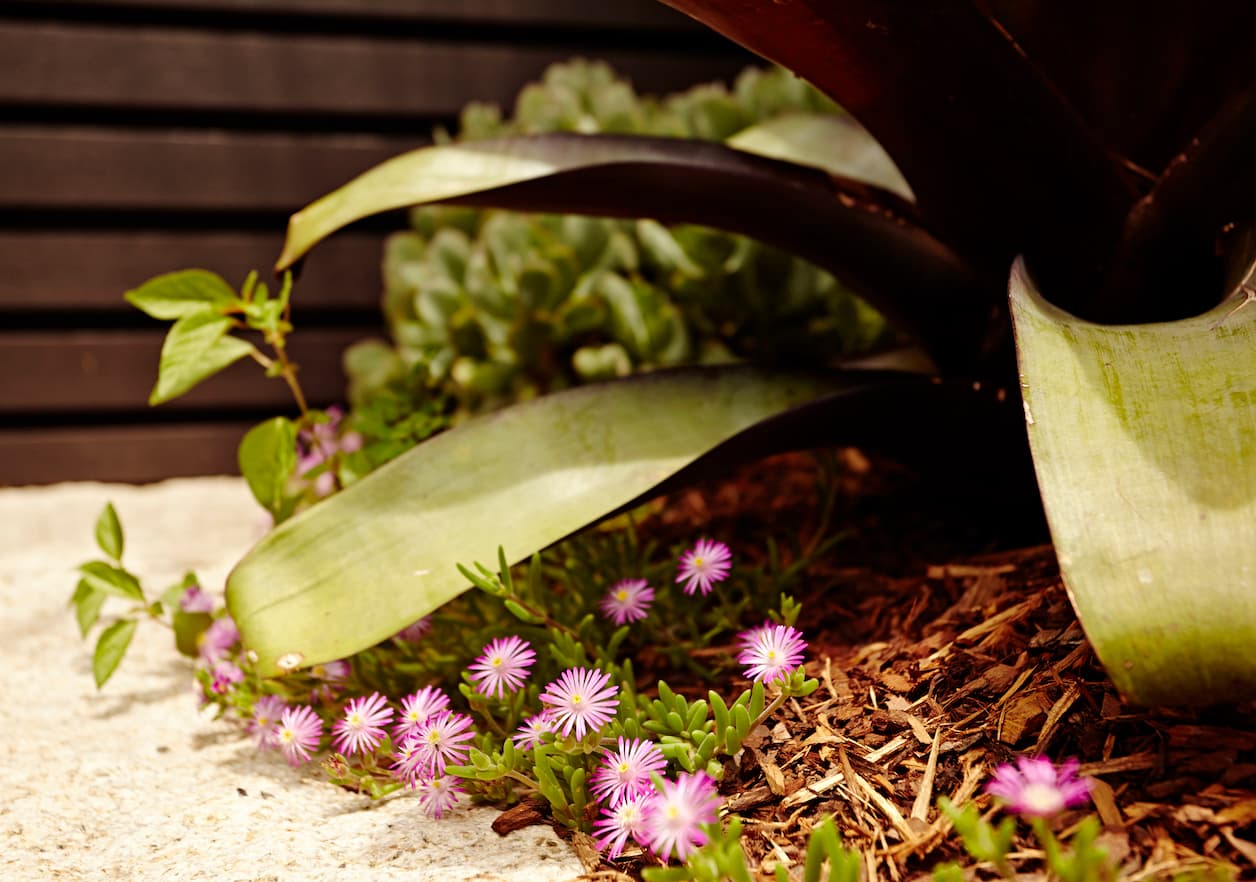
Mulch is one of the simplest ways to help a Sydney garden cope with hot, dry weather. Applied well, it slows moisture loss, buffers the soil from temperature extremes, suppresses weeds and gives garden beds a finished appearance.
It is particularly valuable when an El Niño pattern or a run of hot days places extra pressure on plants. But mulch is not a substitute for good soil preparation or deep, well-timed watering. The material, depth and way it is applied all affect whether rain and irrigation can reach the soil below.
At Growing Rooms, we favour natural brown mulches that sit comfortably with the planting and materials around them. Two products we regularly use are Forest Fines® and Pine Bark Mini Nuggets® from Australian Native Landscapes (ANL), one of our landscape suppliers.
What does mulch actually do?
A layer of mulch acts as a protective cover over bare soil. It can:
- reduce evaporation after watering or rain
- shade the soil and moderate root-zone temperatures
- limit the light available to germinating weed seeds
- reduce soil splash and surface crusting during heavy rain
- protect the soil surface from drying winds
- add organic matter gradually as an organic mulch breaks down
These benefits are most useful when the soil beneath the mulch is already healthy and moist. Covering dry, water-repellent or compacted soil does not correct the underlying problem. It can simply make that problem harder to see.
The two mulches we use most often
Forest Fines®
ANL Forest Fines® is a fine, 15 mm natural timber chip. Its understated colour and relatively even texture create a neat finish without competing with foliage, stone or timber.
We use it frequently in detailed residential garden beds, including mixed native and exotic planting. The smaller particle size makes it easy to spread around closely planted areas and groundcovers. ANL identifies moisture retention, weed suppression and soil insulation among its benefits.
Because it is an organic product, its colour and texture soften as it ages and it will gradually break down. That is part of its appeal: the mulch becomes visually quieter and contributes organic material to the soil over time.

Pine Bark Mini Nuggets®
ANL Pine Bark Mini Nuggets® is a 25 mm graded pine-bark product made from plantation-timber by-product. It has a natural brown colour and a chunkier, more defined texture than Forest Fines®.
We use small pine bark where we want the mulch to remain visible as a deliberate, consistent finish. Bark-based mulches generally break down more slowly, so they can be a useful option in formal beds or areas where a longer-lasting surface is desirable.

Why we avoid red mulch
We do not use bright red mulch in our gardens. Its strongly manufactured colour tends to pull attention away from the plants and hard landscape, rather than helping the garden feel cohesive.
Natural browns sit more quietly alongside sandstone, timber, concrete and foliage. They also weather more gracefully, so the garden does not rely on an artificial colour remaining bright to look finished.
Mulch should support the design, not become the first thing you notice.
Match the mulch to the garden
There is no single product that suits every position. Before choosing, consider:
- the style of the garden and surrounding materials
- how closely the bed is planted
- whether the site is flat, sloping or exposed to wind
- how quickly you want the material to break down
- the soil type and how readily water penetrates it
- whether the area is beside a building, path or pool
- how the bed is irrigated
A finer natural mulch is useful where plants are closely spaced and a subtle finish is wanted. A chunkier bark can provide more visible texture and may last longer. Mineral mulches such as gravel may suit certain succulent, fire-conscious or highly architectural gardens, although their heat, weight and relationship to the soil must be considered.
In vegetable beds, rapidly breaking-down materials such as straw may be more appropriate than decorative bark because the soil is cultivated and replenished more often. The product should always suit the plants and the way the space is maintained.
Prepare the soil before mulching
The work beneath the mulch matters more than the surface finish.
1. Remove weeds first
Remove established weeds, including roots and runners. Mulch can reduce new germination, but it will not reliably stop vigorous perennial weeds that are already growing.
2. Check the soil
Make sure water can enter the soil rather than running across the surface. If the soil has become dry and water repellent, improve it before covering it. Depending on the site, this may involve carefully adding organic matter, using an appropriate wetting agent or addressing compaction and drainage.
3. Feed where appropriate
If the plants need fertiliser or compost, apply it before the mulch. The product and rate should suit the planting; more is not automatically better, particularly around Australian natives that may be sensitive to phosphorus.
4. Water deeply
Water the garden well before mulching. Mulch is most effective when it helps retain moisture that is already in the soil.
How deeply should mulch be applied?
For most established ornamental garden beds, aim for an even layer of approximately 50–70 mm. This is generally deep enough to shade the soil and suppress many weeds while still allowing water to move through.
More is not necessarily better. If mulch is piled too deeply, light rainfall and short irrigation cycles may wet the mulch without reaching the soil. Fine material can also compact when applied in a very thick layer.
ANL recommends a 50–75 mm installation depth for Forest Fines®. Gardening Australia similarly advises keeping garden-bed mulch to a maximum of about 70 mm so water can penetrate.
If an existing bed still has a sound layer of mulch, rake it lightly and measure what remains before ordering a full replacement. Often the garden needs a top-up, not another complete layer.
Keep mulch away from trunks and stems
Leave a clear collar around the base of trees, shrubs and smaller plants. Do not mound mulch against trunks or bury the plant crown.
Constant moisture against bark and stems can encourage decay and fungal problems. A visible gap also makes it easier to inspect the plant and ensures the root flare of a tree is not gradually buried.
Take similar care beside buildings. Maintain the required inspection and clearance zones, and check garden edges regularly for termite activity rather than assuming any organic mulch is termite-proof.
Coordinate mulch with irrigation
Mulch and irrigation should work together. Dripline beneath the mulch can deliver water directly to the soil and reduce surface evaporation, but it still needs to be checked.
Before topping up a bed:
- run the irrigation and look for blocked or damaged emitters
- confirm water is reaching the root zones rather than paths or walls
- check that short watering cycles are penetrating below the mulch
- adjust the schedule as seasons and rainfall change

Mulch makes watering more effective; it does not remove the need to water. During very hot weather, newly planted gardens and moisture-loving plants may still need close attention.
How much mulch do you need?
Measure the length and width of the bed to calculate its area, then multiply by the intended depth in metres.
For example:
- a 20 m² garden bed
- multiplied by 0.05 m depth
- requires approximately 1 m³ of mulch
ANL gives the same broad coverage guide for Forest Fines®: one cubic metre covers about 20 square metres at 50 mm deep. Allow for curved beds, established plants and variations in the ground level, and speak with the supplier if access or delivery is complicated.
When should mulch be topped up?
Spring is an ideal time to inspect garden beds before summer heat arrives, but the condition of the bed matters more than the calendar.
Top up when the layer has broken down enough to expose soil, weeds are germinating readily or water is evaporating quickly. Before adding more, rake the old layer, remove weeds and check the soil beneath. If the existing mulch has formed a dense mat, loosen or remove sections rather than burying the problem.
Mulching after rain or deep watering is particularly effective because it helps hold that moisture in the soil.

Common mulching mistakes
Avoid:
- applying fresh mulch over dry, hydrophobic soil
- piling mulch against trunks, stems or building walls
- creating an excessively deep layer that stops light rain reaching the soil
- topping up repeatedly without checking how much old mulch remains
- expecting mulch to smother established weeds
- covering irrigation before testing it
- choosing a colour that fights with the garden rather than supporting it
A small job with a significant effect
Mulch is not the most glamorous part of a garden, but it has an important role in how the landscape performs through summer. The right natural material, applied to prepared soil at an appropriate depth, can help water go further and keep planting looking settled and cohesive.
For more hot-weather preparation, read How to Prepare Your Garden for an El Niño Summer and Is an Irrigation System More Water-Efficient Than Hand Watering?. If your beds need seasonal maintenance or irrigation adjustments, contact the Growing Rooms team.